 Türkçe
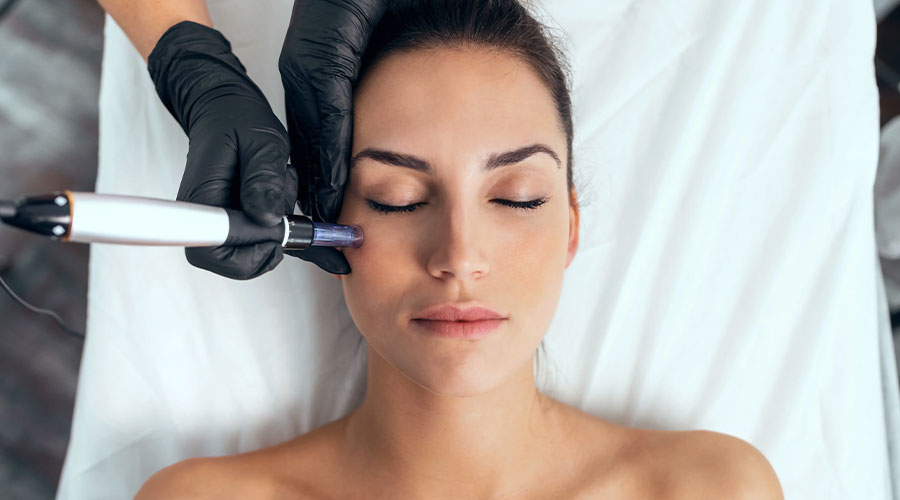
What is Dermapen Treatment?
Dermapen treatment is an advanced medical skin renewal procedure that aims to activate the skin’s own natural healing mechanisms by opening controlled micro-needle holes in the skin and thereby stimulating collagen and elastin production. This application, also known as microneedling, is performed by numerous fine needles at the tip of a special motorized device contacting the skin at a certain depth and at a certain speed. This controlled micro-trauma created in the skin activates the body’s natural wound healing process; it triggers the secretion of growth factors, the activation of fibroblast cells, and the formation of new collagen fibers. As a result, dermapen treatment offers a holistic skin rejuvenation procedure that intervenes simultaneously in many different skin problems such as wrinkles, spots, pores, acne scars, and sagging by renewing the skin from the inside out.
One of the most important advantages of dermapen treatment is that the mechanism it uses is completely biologically based. This approach, which activates the body’s own healing capacity instead of a chemical substance or an external energy source, starts an extremely natural renewal process compatible with the person’s own biology. Compared to laser treatments, its ability to be applied safely to every skin tone and every skin type, the fact that it does not require a significant downtime, and its offering of a much more accessible cost profile are the main features that make dermapen treatment an extremely attractive option in the field of medical aesthetics.
The microneedling technique, first developed by Dr. Desmond Fernandes at the end of the 1990s, made a great leap forward with the Dermapen brand launching its automatic motorized device in 2009 and reached its current popularity. The needle depth control, application speed adjustment, and vibration mechanism provided by the Dermapen device offer a much safer, much more effective, and much more customizable application experience compared to standard derma rollers. Dermapen treatment, which is receiving increasing demand in medical aesthetic clinics in Turkey, is successfully applied by experienced physicians and aesthetic specialists at international standards.
How Does Dermapen Treatment Work?
Understanding the mechanism of action of dermapen treatment is of great importance in terms of developing realistic expectations from this procedure and correctly evaluating the session results.
During dermapen treatment, the fine needles at the tip of the device contact the skin at a right angle, creating microscopic channels in the epidermis and dermis layers. Since these channels are only a few tens of micrometers wide, they do not create a visible wound; however, they carry the quality of a sufficient warning to activate the body’s biological alarm system. In response to this warning, platelets are activated and release growth factors such as PDGF, TGF-β, and EGF. Growth factors activate fibroblast cells; activated fibroblasts synthesize new collagen type I, type III, and elastin fibers. These newly synthesized structural proteins strengthen the skin tissue from within, softening wrinkles, reducing spots, shrinking pores, and smoothing the skin surface.
Another critical effect of dermapen treatment is the temporary penetration pathways created by the microscopic channels. During and immediately after the application, therapeutic substances such as active serum, growth factor, hyaluronic acid, or PRP can be transmitted to much deeper tissue layers through these channels. This transdermal delivery effect ensures that dermapen treatment gains a biological power that goes far beyond its mechanical stimulation effect, and the synergistic effect in combined protocols emerges thanks to this mechanism.
In Which Skin Problems is Dermapen Treatment Effective?
Dermapen treatment has an extremely wide range of indications, but it produces stronger and faster results in some skin problems compared to others.
- Wrinkles and fine lines: Through the stimulated collagen synthesis, it significantly softens dynamic wrinkles especially around the eyes, forehead, and mouth.
- Acne scars and pitted scars: It is among the methods with the strongest non-invasive evidence of efficacy in the literature; collagen restructuring fills the pitted scar tissue and eliminates surface irregularities over time.
- Skin sagging and loosening: Fibroblast activation and collagen production tighten the skin tissue from within, creating a distinct tightening effect.
- Pigmentation problems and skin spots: Effective results are obtained in problems such as sun spots, melasma, and post-inflammatory hyperpigmentation thanks to the acceleration of cell renewal and much deeper delivery of active brightening serums.
- Large pores and oily skin: Newly formed collagen fibers support the area around the pores, shrinking the pore appearance.
- Hair loss: Applied to the scalp, it increases the penetration of treatments such as follicle activation, PRP, and mesotherapy, and supports hair growth.
- Scars and surgical scars: It significantly reduces the prominence of scars by restructuring the fibrotic scar tissue.
To Whom is Dermapen Treatment Suitable?
Dermapen treatment is an inclusive procedure that can be applied to almost every skin type and across a wide age range. This feature makes it accessible to a much wider patient base compared to intense energy-based treatments such as laser. Individuals aiming for skin rejuvenation and wrinkle treatment, those experiencing acne scars and pitted scar problems, those complaining of skin spots and pigmentation irregularities, individuals struggling with sagging and loosening, those experiencing large pores and oily skin problems, those looking for a non-invasive solution against hair loss, and everyone who wants to raise general skin quality constitute a suitable candidate profile for dermapen treatment.
Especially for individuals with dark skin tones, the fact that the risk of hyperpigmentation, which is prominent in laser treatments, remains at a much lower level in dermapen treatment makes this procedure a safely preferred option for every skin color. In contrast, the application should be postponed or presented for expert physician evaluation in the following situations: active acne lesions, skin infection or inflammatory skin disorders such as rosacea, pregnancy and breastfeeding period, predisposition to keloid (excessive scar tissue formation), use of blood thinners, active herpes simplex infection, and autoimmune skin diseases.
How is Dermapen Treatment Applied?
Dermapen treatment is a procedure carried out within the framework of a meticulous protocol and every stage is of great importance in terms of safety and efficacy.
- Preparation and cleaning: The face is cleaned of makeup, oil, and all superficial impurities. The skin being clean and dry is a critical prerequisite for both the safety of the application and the efficacy of serum penetration.
- Anesthesia application: Topical anesthetic cream is applied to the surface and waited for 20 to 45 minutes; this duration both minimizes the sensation of discomfort and ensures the anesthesia is fully effective.
- Needle depth adjustment and application: Needle depth is adjusted according to the anatomical structure of the target area and the condition of the skin. While a depth of 0.25 to 0.5 millimeters is used in thin skin areas such as the forehead and eye area, it can go up to 1.5 to 2.5 millimeters in acne scars and thicker skin areas. The device is applied by making systematic passes over the face; each area is processed with equal density.
- Serum application: Hyaluronic acid, growth factor, Vitamin C, PRP, or special active serums are applied to the skin through the micro-channels opened during or immediately after the procedure, ensuring these serums reach much deeper layers. This stage multiplies the efficacy of the dermapen treatment. The procedure is completed in an average of 30 to 60 minutes.
Active Serums Used with Dermapen Treatment
Active serums delivered to the depths of the skin through the micro-channels opened by dermapen treatment are a critical complementary element that doubles or triples the efficacy of the procedure. The serum to be used is determined according to the person’s skin problem and treatment goal.
- Hyaluronic acid serum: It is the most frequently used and most universally preferred active substance. Hyaluronic acid, which deeply moisturizes the skin, adds volume, and smooths the surface with its strong moisture retention capacity, is the basic complement increasing the efficacy of the treatment.
- PRP (Platelet-Rich Plasma): It creates a synergistic tissue renewal effect by delivering growth factors obtained from the person’s own blood to much deeper tissue layers. This combination is also called “Vampire Facial”.
- Vitamin C serum: It is a valuable complement that adds pigmentation removal and anti-aging dimensions with its antioxidant effect and collagen synthesis support.
- Growth factor serums: These are biological active substances that accelerate collagen renewal by directly supporting fibroblast activation.
- Peptide serums: These are among the complements that stimulate collagen synthesis and strongly support anti-aging effects.
What are the Types of Dermapen Treatment?
Dermapen treatment is not limited to a single type of protocol; various versions aimed at different skin problems and different treatment goals are available.
- Classic dermapen treatment: The standard protocol covering only the microneedling mechanical effect and applied for general skin rejuvenation, pore tightening, and skin surface improvement goals.
- Dermapen combined with PRP: An advanced protocol where platelet-rich plasma obtained from the person’s own blood is delivered to the deep layers of the skin, offering the strongest tissue renewal effect.
- Dermapen combined with mesotherapy: An approach that highlights the skin nourishing effect where vitamin, mineral, and growth factor cocktails are delivered through micro-channels.
- Dermapen combined with radiofrequency (RF Microneedling): This next-generation platform, which also transmits radiofrequency energy from the needle tips, provides both mechanical collagen stimulation and thermal energy-induced tightening effects simultaneously.
- Scalp dermapen application: The protocol applied with customized needle depth to the scalp to support follicle activation and hair growth.
In How Many Sessions Does Dermapen Treatment Yield Results?
Results in dermapen treatment emerge gradually and change according to the person’s initial skin condition, the targeted problem, and the protocol applied. An instant increase in radiance and superficial smoothing can be observed after the first session. However, considering that collagen synthesis is a biological process and matures over time, truly deep effects show themselves after the completion of several sessions.
In general skin quality improvement and radiance increase goals, 3 to 4 sessions constitute a largely sufficient initial protocol. In acne scar and pitted scar treatment, a longer and more intense protocol is required; significant improvement is obtained with the completion of an average of 6 to 8 sessions. Leaving a 4 to 6-week waiting period between sessions is mandatory for the full completion of collagen renewal. The first distinct results are generally observed after 2 to 3 sessions; the most comprehensive and most permanent results reach full maturity 3 to 6 months after the last session.
Recovery Process After Dermapen Treatment
The recovery process after dermapen treatment is quite fast and affects daily life at a minimal level. Redness and a slight heat sensation are observed in the face immediately after the procedure; this appearance resembles a slight sunburn and mostly passes spontaneously within 24 to 48 hours. For the first 24 hours, the face should not be washed, makeup should not be applied, and no active skin care product should be used. This period is of critical importance for the closing of micro-channels and the full absorption of the active serums applied. For the first 2 to 3 days, the skin may appear a little drier than normal and tend to peel slightly; this is normal and is a natural reflection of accelerated cell renewal. Avoiding direct sun exposure and using broad-spectrum sunscreen is of great importance during the first 2 to 4 weeks. The use of products with aggressive active ingredients such as Retinol, AHA, BHA, and benzoyl peroxide should be postponed for the first week. Intense exercise, sauna, and Turkish bath are not recommended for the first 48 hours, while swimming pools and the sea are among the environments to be avoided for the first week.
Difference Between Dermapen and Derma Roller
Dermapen treatment and derma roller are two different microneedling methods that are frequently confused but differ significantly in terms of safety, efficacy, and technical features.
- Mechanism: In dermapen treatment, a motorized device contacts the skin at a right angle, inserting the needles in a fully vertical direction and at a controlled depth. This vertical movement creates minimum tissue damage while providing maximum collagen stimulation. In the derma roller, the needles pass through the skin in a circular motion; this slanted entry and exit movement carries the risk of creating micro-tears and more tissue damage in the skin.
- Depth Control: Dermapen treatment can adjust the needle depth with a precision of one-tenth of a millimeter and can change this depth flexibly according to different areas of the face. In the derma roller, this sensitive control is not possible.
- Hygiene: In dermapen treatment, single-use sterile cartridges are used for each session; this completely eliminates the risk of cross-contamination. In derma rollers, there are serious hygiene risks regarding product life and sterilization.
Frequently Asked Questions About Dermapen Treatment
1- Is dermapen treatment a painful procedure?
Thanks to the topical anesthetic cream applied before dermapen treatment, the sensation of discomfort during the procedure is largely minimized. After the anesthesia effect is fully established, most people describe the procedure as a slight scratching or vibration sensation; overall, it is evaluated as a quite tolerable experience.
2- Can dermapen treatment be applied to every skin tone?
Dermapen treatment can be safely applied to almost every skin tone, from fair skin color to very dark skin color. The risk of hyperpigmentation that laser treatments can create in dark skin tones remains at an extremely low level in dermapen treatment. This feature is one of the most important advantages making it a safely preferred option for every skin color.
3- How often should dermapen treatment be repeated?
Dermapen treatment sessions are generally planned at 4 to 6-week intervals. This waiting period is mandatory for the completion of collagen renewal. After an initial protocol of 3 to 8 sessions is completed according to the targeted problem, results are protected and strengthened with maintenance sessions every month or every two months.
4- What is the difference between dermapen treatment and laser treatment?
Dermapen treatment activates the body’s own biological response through mechanical micro-trauma, while laser treatment creates a thermal effect on the tissue through light energy. While laser can handle certain pigments and vascular structures much more targetedly, dermapen treatment stands out with its ability to be applied to every skin tone, its lack of downtime, and its much wider range of indications.
5- When can makeup be done after dermapen treatment?
It is recommended not to do makeup for the first 24 hours after dermapen treatment. This period is of critical importance for the closing of micro-channels and the skin completing its initial healing. After 24 hours, makeup can be returned to by preferring light and mineral-based makeup products.
