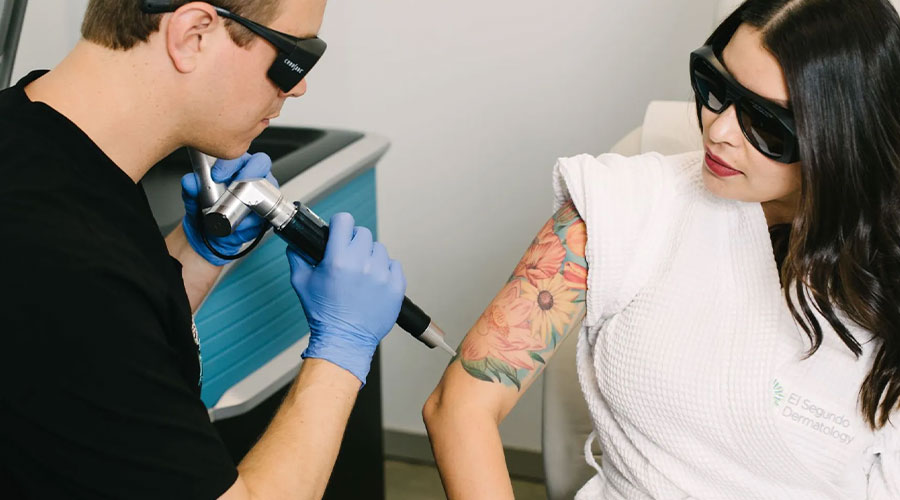
What Is Laser Hair Removal?
Laser hair removal is a medical aesthetic procedure applied to permanently reduce or completely eliminate unwanted hair at the follicle level. Based on the principle of selectively targeting the melanin pigment in the hair follicle with laser beams, this method aims to permanently disable the follicle without damaging the surrounding tissue. Unlike temporary methods such as shaving, waxing, threading, and epilators, laser hair removal blocks hair growth at its source, offering a long-lasting and comfortable hair-free experience.
The fundamental working principle of laser hair removal is based on the law of physics known as selective photothermolysis. According to this principle, laser beams of specific wavelengths are absorbed only by the target chromophore, which is melanin; the melanin heats up and this heat is transferred to the follicle cells, permanently limiting the follicle’s capacity to produce hair again. The surrounding skin tissue is minimally affected by this process. This selective effect is the fundamental mechanism that makes laser hair removal both an effective and a safe procedure.
First introduced into clinical use in the 1990s, laser hair removal technology has undergone tremendous development over the past thirty years. Today, devices operating at different wavelengths and adapted to different skin types are available, most notably diode laser, alexandrite laser, and Nd:YAG laser. This technological diversity has made laser hair removal a method that can be safely applied to a wide patient population ranging from fair-skinned to dark-skinned individuals. Recognized as safe and effective by the World Health Organization and international dermatology authorities, this procedure continues to hold its place among the most widely performed procedures in the field of medical aesthetics today.
How Does Laser Hair Removal Work?
Correctly understanding the mechanism of action of laser hair removal is of great importance both for developing realistic expectations from this treatment and for correctly planning the number of sessions.
The hair growth cycle consists of three phases: anagen (active growth), catagen (transition), and telogen (resting). Laser hair removal can only act on hairs in the anagen phase, meaning those that are actively growing; because at this phase the connection between the follicle and the hair strand is at its strongest and the melanin concentration is at its highest level. Since only twenty to thirty percent of hairs are in the anagen phase at any given moment, there is no possibility of targeting all hairs in a single session. For this reason, laser hair removal requires multiple sessions repeated at specified intervals; in this way, follicles at different growth phases are targeted in each session and the hair density across the entire area is permanently reduced over time.
What Are the Types of Laser Hair Removal?
The laser technologies used in laser hair removal applications operate at different wavelengths and offer different efficacy profiles for different skin types and hair structures.
Diode laser is the most widely used technology in laser hair removal applications today. Operating at a wavelength of 800 to 810 nanometers, diode laser is considered the gold standard thanks to its ability to be applied to both dark and light-toned skin, its deep follicle penetration capacity, and the comfortable application experience it offers combined with effective cooling systems. Alexandrite laser, operating at 755 nanometers, is the laser type that shows the highest affinity for melanin; it delivers extremely fast and effective results on fair and medium-toned skin. Nd:YAG laser, operating at 1064 nanometers, is the laser type that can reach the deepest layers of the skin and stands out as the safest option for dark-skinned individuals. IPL (Intense Pulsed Light) is technically not a laser but a technology using a broad-spectrum light, and its efficacy is considered more limited compared to standard laser devices.
How Many Sessions Does Laser Hair Removal Take?
Laser hair removal results cannot be obtained in a single session; sessions repeated at regular intervals are required to be able to intervene in the different phases of the hair growth cycle. The number and frequency of sessions varies depending on the treatment area, the color and thickness of the hair, skin tone, and the individual’s personal hair growth rate.
In general, the face area is planned as sessions every 4 to 6 weeks, and body areas every 6 to 8 weeks. An average of 6 to 10 sessions is sufficient for permanent hair reduction in most areas, though some areas and some hair types may require more sessions. With each completed session, the hair density in the targeted area gradually decreases; a noticeable reduction generally begins to be observed after the first 3 to 4 sessions.
Pre-Treatment Preparation for Laser Hair Removal
To achieve the best results from laser hair removal and to prevent possible complications, it is necessary to comply with some important rules before the procedure.
At least 4 to 6 weeks before the procedure, hair removal methods that affect the follicle such as waxing, threading, and root dyeing should be avoided; because laser hair removal acts by finding the hair strand present in the follicle. 24 to 48 hours before the procedure, the area to be treated should be shaved with a razor; when the hair strand is not on the surface of the skin, laser energy reaches the follicle directly and the risk of superficial burns is minimized. At least 4 to 6 weeks before the procedure, prolonged sun exposure and solarium should be avoided; sunburned or tanned skin both reduces the safety of the procedure and increases the risk of side effects. The use of broad-spectrum sunscreen is critically important both before and after the procedure.
Area-Specific Laser Hair Removal Applications
Underarm Laser Hair Removal
The underarm area is among the most frequently requested areas in laser hair removal applications. Since the hairs in this area are generally thick and dark-colored, they absorb laser energy at a high rate; this characteristic is the fundamental factor that makes underarm laser hair removal extremely successful in terms of efficacy. Permanent hair reduction can be achieved with an average of 6 to 8 sessions. Due to the sensitive structure of the underarm area, the use of devices with cooling systems significantly increases the comfort of the procedure. Underarm laser hair removal provides great comfort in this area both aesthetically and hygienically, as it eliminates problems such as skin irritation, darkening, and inflammation caused by shaving, waxing, and deodorant use.
Leg Laser Hair Removal
The leg area has the largest surface area among laser hair removal applications. In leg hair removal, which is evaluated in two separate sections as below the knee and above the knee, applying both sections together provides far more comprehensive and complete results. Since leg hairs can generally be fine and light-colored, stronger laser energy or more sessions may be required. Permanent hair reduction is achieved with an average of 6 to 10 sessions. This application, which is in particularly high demand before the summer months, significantly simplifies the daily care routine by largely eliminating the need for regular shaving and waxing.
Genital Area Laser Hair Removal
Bikini and genital area laser hair removal is an application that requires special care and experience due to its sensitive anatomical structure. While partial bikini hair removal shapes the bikini line, full genital area hair removal aims to permanently reduce all hair in the entire area. Since the skin in this area is thin and sensitive, lower energy settings and more advanced cooling systems must be used, particularly in dark-skinned individuals. Permanent results can be achieved with an average of 6 to 10 sessions. Genital area laser hair removal is attracting increasing demand due to practical benefits such as the ease it provides in terms of hygiene, the elimination of skin irritation caused by shaving and waxing, and the reduction of the daily care burden. Prior to the application in this area, an evaluation must be conducted by an experienced and specialized physician or healthcare professional.
Back and Chest Laser Hair Removal
The back and chest areas are among those with the highest laser hair removal demand, particularly in male patients. The hairs in these areas are generally thick, dark-colored, and spread over a wide area; these characteristics cause laser energy to be absorbed at a high rate, increasing efficacy. While the back area constitutes one of the largest hair removal surfaces on the body, the chest area is characterized by dense hair structure over a smaller surface. In both areas, noticeable and permanent results are achieved with an average of 6 to 8 sessions. Back laser hair removal provides a great advantage both aesthetically and practically, particularly due to offering a long-term solution in this area where regular maintenance is difficult.
Facial Laser Hair Removal
Laser hair removal on the face is most frequently applied in areas such as the upper lip, chin, cheeks, and under the jaw. Since facial skin has a thinner and more sensitive structure compared to other parts of the body, the energy settings and device selection to be used in facial laser hair removal must be determined with particular meticulousness. The upper lip area, despite being a smaller area, requires careful application due to its dense hair structure and sensitivity. In cases where hormonal factors are directly related to facial hair growth, a hormonal evaluation is also recommended in addition to laser hair removal; otherwise, the continuation of hormonal imbalance may pave the way for new hair growth. Permanent hair reduction is achieved with an average of 6 to 8 sessions.
Arm Laser Hair Removal
Arm laser hair removal can be planned to cover the entire arm or only the forearm area. Since arm hairs are generally fine and light-colored, slightly more sessions may be required compared to other areas. However, with the correct laser selection and energy settings, very successful results are achieved. Permanent hair reduction can be achieved with an average of 6 to 10 sessions.
Abdominal Laser Hair Removal
Abdominal laser hair removal is particularly preferred for removing hair extending along the belly line and permanently reducing hair on the central line of the abdomen. The hairs in this area are generally fine in structure; however, laser delivers extremely effective results on dark-colored hairs. An average of 6 to 8 sessions is sufficient.
Shoulder and Neck Laser Hair Removal
Shoulder and neck laser hair removal is frequently preferred particularly in male patients for correcting the hairline and removing hair on the back of the neck. Although the skin of the neck area is relatively sensitive, laser hair removal performed by an experienced practitioner with correct energy settings can be safely applied in this area as well.
Points to Consider After Laser Hair Removal
Complying with several important rules after laser hair removal both accelerates the healing process and prevents possible side effects.
Immediately after the procedure, redness and mild swelling may be observed in the treatment area; these symptoms generally resolve on their own within a few hours to one day. Cold compresses can speed up the resolution of these symptoms. For at least 48 hours after the procedure, sauna, Turkish bath, hot showers, and intense exercise should be avoided. Avoiding direct sun exposure and using broad-spectrum sunscreen is of great importance for the first 4 to 6 weeks after the procedure. Perfumed products, acidic creams, and irritating substances should not be applied to the treatment area for the first 48 hours. After the procedure, hairs do not shed immediately; since hairs separating from the follicle will shed gradually within a few weeks, pulling at the hairs or waxing during this process is strictly not recommended.
Frequently Asked Questions About Laser Hair Removal
1- Is laser hair removal permanent?
Laser hair removal is not defined as a fully permanent hair removal method in the strict sense; instead, it is defined as permanent hair reduction. After the session protocol is completed, permanent hair reduction of between eighty and ninety percent is achieved in the vast majority of cases. Over time, some hairs may regrow due to hormonal changes or individual factors; in such cases, maintenance sessions of one or two sessions per year are sufficient.
2- Is laser hair removal a painful procedure?
The discomfort felt during laser hair removal varies depending on the device used, the treatment area, and the individual’s sensitivity level. Modern devices with cooling systems largely minimize the discomfort during the procedure. Most people describe the procedure as a rubber band snap or a mild burning sensation. In sensitive areas, the discomfort can be further reduced by using a topical anesthetic cream before the application.
3- Can laser hair removal be applied to every skin type?
Thanks to today’s laser technologies, laser hair removal can be applied to almost every skin type. While Nd:YAG laser stands out as the safest option for dark-skinned individuals, diode and alexandrite laser offer more effective results for fair-skinned individuals. Postponing the application is recommended on tanned or sunburned skin.
4- Can laser hair removal be performed during pregnancy?
Laser hair removal should not be performed during pregnancy and breastfeeding. Since there is insufficient clinical data on the effects of laser energy on the developing baby, avoiding the application during this period is the standard medical approach. Laser hair removal can be started after the period of delivery and breastfeeding has ended.
5- What is the difference between laser hair removal and IPL?
While laser hair removal uses a laser beam operating at a single and specific wavelength, IPL emits a broad spectrum of light. This difference is decisive in terms of efficacy; laser energy targets the follicle in a much more precise and concentrated manner, whereas IPL disperses over a wider area, producing a less concentrated effect. For this reason, laser hair removal delivers far more permanent results in fewer sessions compared to IPL and is recognized as a superior method by international dermatology authorities.
 Türkçe